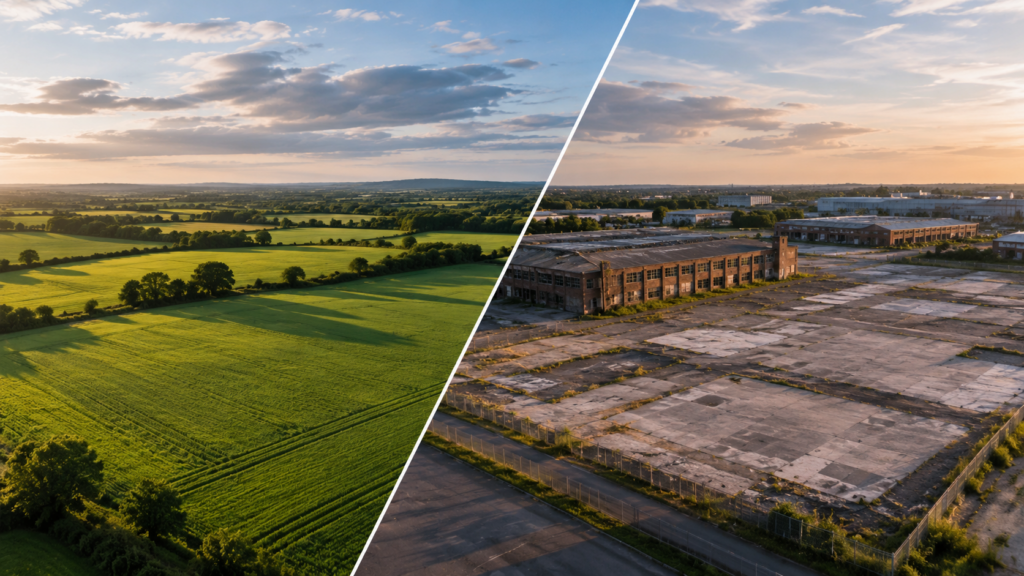
Drive into almost any town in the UK and you’ll pass the same kind of place. An industrial estate on the edge of the centre: a plumbing supplier, a couple of car garages, a welder, a haulage yard, a skip hire firm, a self-storage unit. Corrugated roofs, a lot of hardstanding, and often a substation not far away.
Now look at where data centre developers have been trying to build. Farmers fields on the edge of villages. Green Belt land around the M25. In Abbots Langley, Hertfordshire, a campus on Green Belt land was refused by the local council and only went ahead after the government stepped in. Across Europe, greenfield has gone from 8% to 39% of the data centre pipeline, according to CBRE.
We think the industry is looking in the wrong place.
Why does greenfield cause so much trouble?
Because it takes something away. A field is a view, a dog walk with family, a bit of countryside people assumed would always be there. When a developer turns up with plans for a data centre on it, people are suddenly picturing a vast grey building outside their bedroom window. The community isn’t just weighing up a building. It’s losing something it values, and that’s a hard argument to win, whatever the water numbers say.
An industrial estate is different. Nobody campaigns to save a scrapyard.
What do these sites already have?
More than you might think. They’re already zoned for industrial use, so the principle of development is established. They have road access built for heavy vehicles. Some have decent power supplies already. And the neighbours are used to living next to commercial activity.
They’re also the right size for where demand is heading. A hyperscale training campus needs hundreds of acres. A 10 to 20MW inference site doesn’t. It can fit on a few consolidated plots, close to the towns and businesses it serves.
What could the community get out of it?
This is where it gets interesting. A well-designed data centre could replace a tired, patchwork estate with a modern building, proper landscaping and far fewer lorries than a haulage yard. Waste heat could warm nearby homes or a leisure centre, as it already does in Tallaght and Frankfurt. For a council trying to regenerate the edge of town, that’s a very different conversation from losing a farmer’s field or a countryside walk.
So why isn’t it happening?
Because it’s harder. Industrial estates usually have lots of landowners and tenants, and putting a site together means negotiating with every one of them. Contaminated ground has to be dealt with. And a power supply that suits a welder won’t suit a data centre without serious upgrades.
There’s a real tension to manage too. Those plumbing suppliers and garages are local businesses with local jobs. Push them out with nowhere to go and you’ve swapped one kind of pushback for another. The developers who get this right will help existing businesses move somewhere better, not just buy them out.
And brownfield land is in demand. The countryside charity CPRE says England’s brownfield registers have room for almost 1.5m homes, and housing will win a political fight with a data centre every time. The smart move is to target employment land that isn’t suitable for homes, rather than competing for the plots that are.
Brownfield isn’t a free pass, either. In this month’s US midterms, voters in Janesville, Wisconsin backed a rule requiring a public vote before the old GM car plant can become a data centre. It was one of nearly 40 local ballot measures on data centres, and almost all of them went against the industry. The lesson isn’t to avoid brownfield. It’s that the community has to want what replaces it.
None of this is as simple as buying a field. But a field is only simple until the first public meeting.
Is it worth the effort?
We think so. Greenfield looks quicker on paper. In practice, the farmland sites are the ones ending up in court. A site the community is glad to see redeveloped is worth a lot of extra legwork.
Maybe it’s time the industry stopped looking at the edge of the map and started looking at the edge of town.
